Procurement transformation has become a constant priority for organisations seeking greater efficiency, resilience and value creation. Yet many procurement teams face the same challenge: there are more opportunities for transformation than there are resources available to pursue them.
The question is no longer whether to transform, but where to focus first.
The most successful procurement teams do not view transformation as a one-time programme with a defined end point. They continually adapt to changing business priorities, stakeholder expectations, market conditions and emerging risks.
Too often, transformation initiatives begin with a technology discussion rather than a business challenge. Successful organisations reverse that approach by identifying where procurement can create the greatest business impact before determining the necessary changes in process, capability, operating model, data and technology.
Key questions leaders should ask:
- Where can Procurement create the greatest business value?
- Which initiatives align most closely with organisational priorities?
- What capabilities are currently limiting performance?
- Where are stakeholders experiencing the greatest friction?
- What can realistically be delivered with available resources?
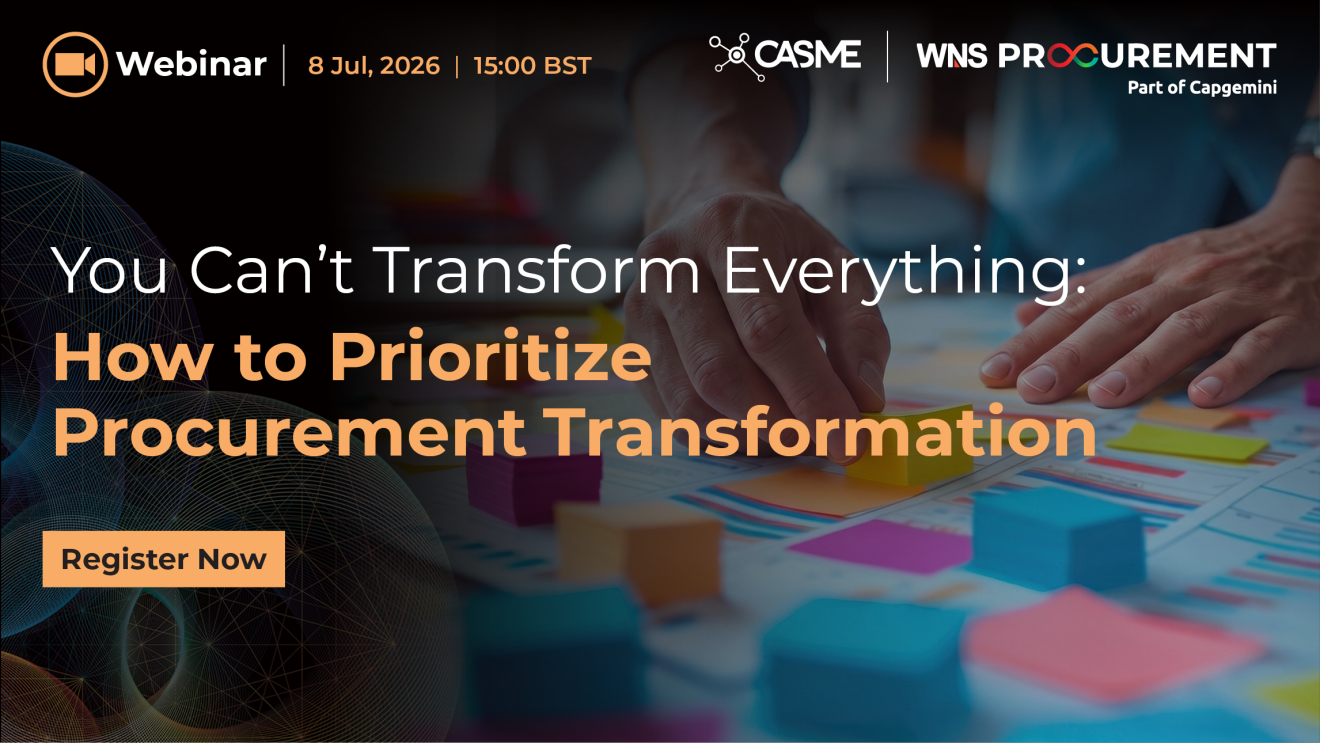
These are some of the questions CASME's Graham Crawshaw and Matthew Bardell from WNS Procurement (Part of Capgemini) will be exploring during our upcoming complimentary webinar:
You Can't Transform Everything: How to Prioritise Procurement Transformation
📅 Wednesday 8 July 2026
🕒 3:00pm BST | 4:00pm CEST | 10:00am EDT | 7:00am PDT | 11:00am BRT
📍 Secure your spot.
Back to News
Other News

Expert analysis by Graham Crawshaw FCIPS, Procurement Content Director, CASME
UPDATED: 30 June 2026

Even well-designed procurement strategies can fail to deliver when stakeholders are not aligned.

Every geopolitical shock eventually finds its way into a bank’s cost base, and the current Middle East conflict is no exception.

Procurement data analysis is widely used, but not always well applied.