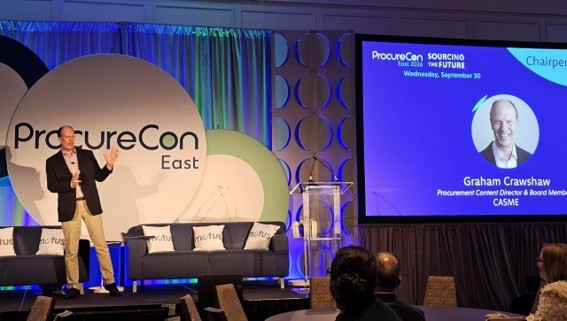
Procurement teams face growing expectations to adopt AI, strengthen resilience, improve supplier relationships and deliver more value. But with so many demands competing for attention, how do leaders decide where to focus? CASME’s Procurement Content Director Graham Crawshaw explores Procurement’s bigger picture through the question that should guide those decisions: “By the end of the ProcureCon East conference, I kept coming back to one simple question - what does the business actually need from Procurement?”
This may sound obvious, but it matters. New technology, new processes, new methodologies, new operating models and new measures of maturity can easily become objectives in their own right. They are not. Their value depends on how they help the business perform.
If the business needs growth, Procurement needs to understand how it enables growth. If margin is under pressure, where can Procurement genuinely improve the economics? If cash matters, what can it do around working capital? If resilience is a priority, where are the vulnerabilities capable of interrupting the business? And if speed matters, are the processes helping the organisation move faster, or slowing it down?
There is not really a separate Procurement agenda. There is a business agenda, and Procurement has to work out how it contributes to it.
That thought connected discussions about AI and operating reality through resilience, governance and supplier value, and then towards executive leadership, stakeholder influence and capability. The common thread was not another transformation programme, it was whether Procurement can focus its resources on the outcomes the wider organisation actually values.
AI: efficiency is only part of the story
AI is understandably everywhere. What is encouraging is that much of the conversation has moved beyond simply asking what AI can do. The better questions are becoming: what problem are we trying to solve? What outcome will improve? Should we build something ourselves or buy capability from the market? What information are we feeding into the technology? How do we govern it? And how much Procurement time should really be spent developing applications rather than using mature capability from specialists?
Procurement teams do not need to become software development teams. Our value should come from knowing where technology can remove friction, improve insight or strengthen a commercial outcome.
There is, however, a more uncomfortable possibility that Procurement leaders should at least consider. It is repeatedly said automation will remove transactional work and free Category Managers to spend more time on strategic activity. That may happen, but the productivity dividend may not all be reinvested in additional strategic capacity. In some organisations, technology may translate into an expectation that Procurement delivers the same, or more, with fewer people.
If your Procurement function had 20% fewer people in three years, which capabilities would you absolutely protect?
That changes the AI conversation. Research, first drafts, contract analysis, data interrogation, pattern recognition, scenario preparation and routine workflow are increasingly open to automation. Understanding the business context, influencing stakeholders, challenging assumptions, applying commercial judgement and navigating difficult supplier relationships are different. They are harder to automate and potentially become more valuable as other work disappears.
The useful question is therefore not simply 'How can AI save me time?' it is 'What parts of our work genuinely require Procurement expertise, and what should technology remove altogether?'. That distinction could become fundamental to future Procurement organisation design.
Resilience needs an economic language
Discussions around tariffs and geopolitics reinforce another shift in Procurement’s thinking. The question is not simply whether globalisation is ending or whether local sourcing is the answer. A more useful question is what should remain global, what should become regional and what genuinely needs to be local? That requires judgement, but it also requires Procurement to explain resilience in terms the business understands.
“Two concepts particularly resonated with me", says Graham. “Total Cost of Resilience and Cost of Inaction. We have spent years moving conversations away from purchase price towards Total Cost of Ownership. Perhaps resilience requires us to move the thinking on again. What does it cost to make a particular supply solution sufficiently resilient? And if an investment in resilience appears difficult to justify through traditional return on investment, what would happen if we did nothing?”
Lost production, missed customer commitments, lost revenue, emergency sourcing, quality failures and management distraction can quickly turn 'risk management' into a business conversation. Procurement's job is not to eliminate every risk. It is to help the organisation understand which risks matter enough to justify action and what level of resilience is economically sensible.
Supplier leverage is built before the negotiation
A similar lesson emerged from the discussions about supplier renewals. As Graham observes: “Your renewal leverage is often lost long before you sit down with the supplier.”
A supplier can become entrenched because of switching costs, technology dependencies, specialist knowledge, accumulated data, operational disruption or internal stakeholder resistance to change. By the time Procurement arrives at the renewal negotiation, many of the choices may already have disappeared.
The practical question therefore goes beyond 'How do I negotiate harder?' to how Procurement creates leverage before renewal: understanding alternatives, managing dependency, developing credible options, involving stakeholders early and knowing where value exists beyond headline price. That is another example of Procurement moving from reacting to events towards shaping the commercial environment before the event occurs.
Start with the stakeholder's priority, not Procurement's proposition
One point from the stakeholder discussion was particularly useful: do not assume cost savings are the right place to start. Savings remain a fundamental Procurement contribution in many organisations, and there will be situations where cost reduction is explicitly the business priority. The broader principle is to start with the stakeholder's priority, not Procurement's proposition.
What are they trying to achieve? What are their pain points? What cannot change? What is their comfort level with risk? What does success look like to them? Use external and internal data to understand the position. Understand the spend, but also understand the value. Explore innovation with suppliers where it is relevant, and recognise that every stakeholder is different.
This is closer to consultative selling than process enforcement. Good Procurement stakeholder management begins with listening, diagnosis and relevance. The objective is not to secure compliance with Procurement's priorities. It is to understand the business priority well enough to show where Procurement can improve the outcome.
The more we automate, the more the remaining human skills matter
One of the most interesting contrasts emerged in the leadership discussions. After so much emphasis on technology, automation, data and new operating models, one of the clearest messages was that the Chief Procurement Officer role ultimately comes back to people.
The practical leadership checklist that followed had remarkably little to do with procurement technology: develop talent, mentor people, challenge them, encourage them, listen, show mutual respect, remove obstacles, learn from failure, create transparency and avoid micromanaging.
Perhaps the irony is that the more technologically sophisticated Procurement becomes, the more its differentiation may depend on very human capabilities.
If AI takes on more analytical and repetitive workload, leadership does not become less important. It becomes more important because the work that remains for people is increasingly dependent on judgement, influence, curiosity, relationships and adaptability. The future leader may therefore need to be more of a generalist, able to connect business priorities, suppliers, data and people, rather than simply being the organisation's most technically accomplished sourcing specialist.
Centres of Excellence should scale capability, not bureaucracy
The same principle applies to the modern Centre of Excellence. The interesting question is not simply whether an organisation needs one. It is which capabilities should be centralised because they allow a leaner Procurement function to perform consistently at scale.
Data and analytics, market intelligence, process design, AI governance, capability development, category tools, supplier lifecycle disciplines and common standards are all candidates. The purpose should be to give Procurement people better information, expertise and infrastructure so they can make better decisions without recreating the same work in every category or business unit.
Governance still matters, but the test should be whether it improves decision quality, accountability and speed. A Centre of Excellence that merely introduces additional approvals, systems and process has missed the point. In a world where resources may become tighter, enablement has to remove effort as well as improve control.
Tail spend is a test of whether we really believe the technology argument
Tail spend provides a practical example. Historically, it has often occupied an uncomfortable space where there is too much activity to manage manually but not enough value in each transaction to justify Category Management attention.
If automation, better data and digital buying channels genuinely work, scarce Category Manager time should not be consumed by low-value repetitive transactions. The opportunity is to create control, compliance and visibility without applying specialist Procurement resource to every purchase.
The prize is not simply to 'manage tail spend better'. It is to decide what should be automated, what should be standardised, where suppliers or platforms can simplify the process, and where human intervention genuinely changes the outcome. Tail spend therefore becomes a useful test of the operating model we say we want: technology handles the repeatable activity, while people focus on decisions where judgement changes business value.
Five questions for Procurement leaders
Drawing these themes together, Graham identifies five questions worth testing inside any Procurement organisation:
1. Business relevance. Which business priorities are we genuinely helping to deliver, and which Procurement activities exist mainly because we have always done them?
2. AI and automation. Which activities should technology remove altogether rather than merely make faster, and what capabilities would we protect if the team became smaller?
3. Resilience. Where have we quantified the Cost of Inaction or Total Cost of Resilience rather than simply describing a risk?
4. Supplier leverage. Where are we allowing dependency, switching costs or stakeholder behaviour to erode our future negotiating position before renewal even begins?
5. Leadership. Are our leaders primarily managing process and activity, or are they developing judgement, influence, talent and the ability to connect Procurement to the business agenda?
The bigger picture
As Graham concludes: “Procurement's future is not about doing more Procurement. It is about becoming more selective about where Procurement adds value.”
Where can Procurement materially influence a business priority? Where is the risk? Where is the commercial opportunity? Where can suppliers contribute more? Where can technology remove work entirely? And where is human judgement indispensable?
AI will undoubtedly form part of that future. So will better data, different operating models, Centres of Excellence and new approaches to supplier management. But none of them is the objective. The objective is business performance.
Procurement may ultimately have fewer people, more technology and greater expectations. That does not reduce the importance of people. It raises the premium on having the right people doing the right work, supported by technology that removes friction rather than adding another layer of complexity.
The future of Procurement will not be defined by how much technology we adopt, but by how boldly we use it to simplify, connect and focus our people on the business outcomes that matter most.
With that combination of technology, judgement, leadership and business relevance right, the Procurement function of the future may be leaner. But it could also be far more relevant, influential and effective.
Back to News
Other News

Marketing Procurement no longer needs to make the case for a strategic role.

Following our recent CASME SpotLight event, we reflect on one of the main questions raised: what separates an approved category strategy from one that is implemented and influences business…

Procurement is expected to move quickly, secure value and give the business access to the suppliers and capabilities it needs.